 French
 German
 Italian
 Arabic
 Japanese
 Spanish
 Korean
 Russian
 Portuguese
 Dutch
Dutch
 Norwegian
 Finnish
 Swedish

What works where: choosing a painting room by room
A painting is judged in the room it hangs in. Light, viewing distance and what the room is for decide the subject and the scale far more than taste does.
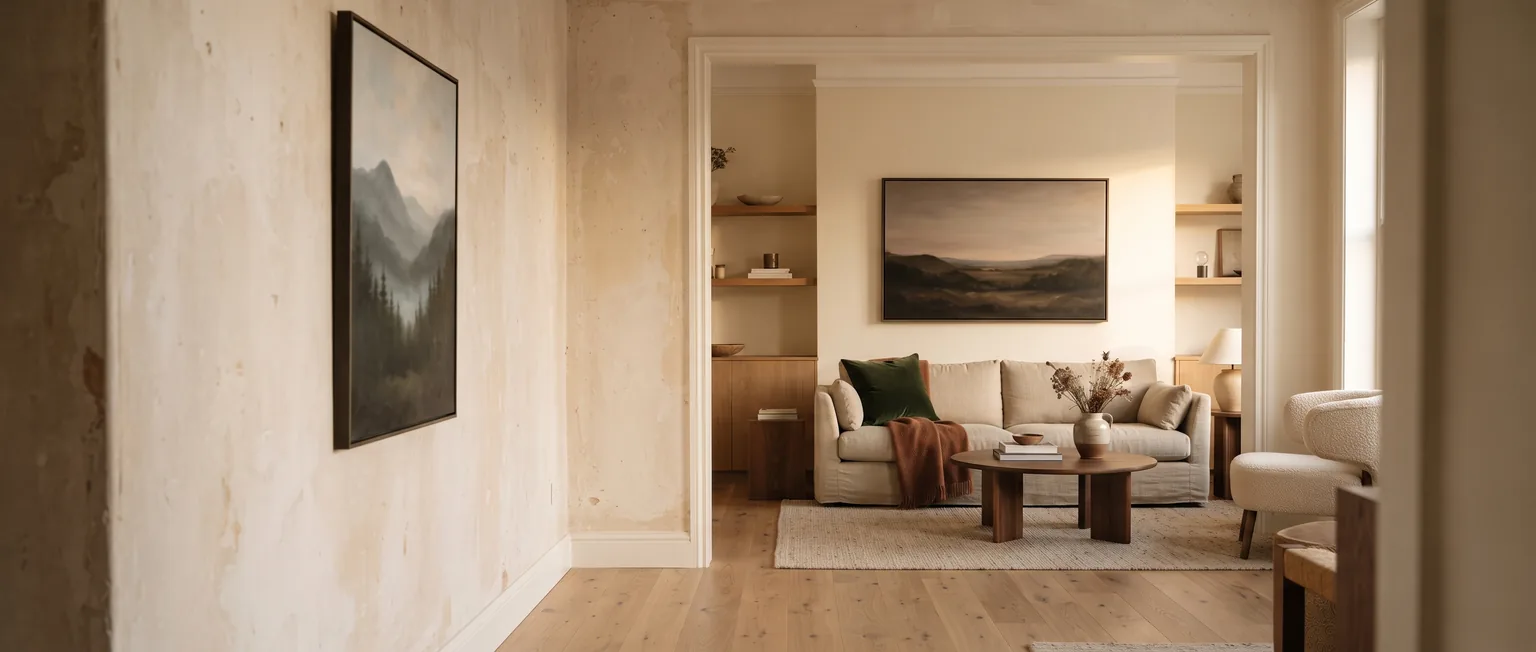
01Living room
The one room where a painting is looked at rather than passed. Viewing distances are long, so this is where a large canvas earns its size: a wide landscape or a city scene above the sofa, sized at roughly two thirds of the furniture below.
Light is usually mixed and indirect here, which flatters a hand-painted surface. If there is one wall the room is arranged around, this is where an oil rather than a print repays the difference.
02Bedroom
Seen from close range and mostly when lying down or half awake, so busy compositions do not survive here. Quiet subjects work: water, mist, blossom, a single figure, an empty landscape.
Above a bed head, keep the painting narrower than the bed and hang it low enough that the two read as one piece. Avoid hard directional light: a lamp aimed at a canvas in a bedroom becomes a glare you cannot ignore at night.
03Dining room
Everybody in this room is seated, so eye level drops by about 40 cm. Hang lower than you would anywhere else, centred on the table rather than on the wall.
Warm subjects hold a room where people linger: markets, harvests, interiors, still life. If the room doubles as a kitchen, keep the painting away from the cooking wall, for the reasons set out in the care guide.
04Hallway and staircase
Passed at speed and from close range, which rules out fine detail: whatever is there has to register in a second. Strong shapes and strong colour work; delicate brushwork is wasted.
A staircase wall takes a vertical composition or a rising series of smaller works. Hang each one at the eye level of the step it faces, not on a single horizontal line, or they will all look wrong from the stairs.
05Office and study
A painting behind a desk is seen by everyone else on a screen, which is now part of the decision. Calm, horizontal, low-contrast subjects hold up on camera; busy ones become noise.
Facing the desk instead, the rule reverses: this is a wall you look at all day, so it can afford a subject that keeps giving something back. Businesses fitting several rooms at once can write to the commission desk about the whole project.
06Hotels, restaurants and public rooms
Different constraints entirely: the work is seen by hundreds of people who did not choose it, under lighting that is fixed, and it has to survive being seen every day by the staff. Series matter more than single pieces, and subjects tied to the place tend to outlast fashionable ones.
Volume, repeat sizes and coordinated framing are handled case by case, and anything painted specially goes through the commission desk.
Paintings in this guide



Questions people ask
Should every painting in a home match?
No, and rooms where they all match tend to look like a showroom. What should be consistent is the framing language: a common moulding family across different subjects reads as a collection, while different frames on similar subjects read as an accident.
Can an oil painting hang in a bathroom or a kitchen?
A bathroom, no: sustained humidity and heat are the two things an oil on canvas does not tolerate. A kitchen is possible away from the cooking wall and any extractor. The care guide covers the detail.
How do I light a painting properly?
Indirect, warm and off to one side. Aim a light at the wall rather than at the canvas, keep it out of direct sunlight, and prefer LED, which emits almost no ultraviolet or heat.
What if I want a view of my own town?
That is a commission rather than a catalogue purchase: a photograph you send, painted at the size you choose. The commissioning guide explains how it runs.
Whatever the room, the size decision comes first and the frame last. If the wall is not measured yet, start there.
Other guides
Hand-painted oil or fine art print
Every painting here is offered in two forms. One is painted with a brush and has a surface you can see across the room; the other is printed and has none. The image, the sizes, the framing and the free shipping are identical.
Choosing the right size
Almost every painting here comes in ten sizes, all of which keep its original proportions. Which one is right is decided by the wall, the distance you see it from and the furniture beneath it, not by the painting.
Rolled, stretched or framed
Three ways to receive the same canvas. One of them decides what you have to do when the parcel is opened, and whether you choose a frame now or leave it open.
Commissioning from your photograph
When the painting you want does not exist, it can be painted from a picture you send. What decides the result is the photograph you choose and the size you settle on before the first brushstroke.
Living with an oil painting
An oil on canvas outlives the people who buy it, provided three things are right: where it hangs, what light falls on it, and what you do - and never do - when it needs cleaning.