 French
 German
 Italian
 Arabic
 Japanese
 Spanish
 Korean
 Russian
 Portuguese
 Dutch
Dutch
 Norwegian
 Finnish
 Swedish

What size does your wall actually need?
Almost every painting here comes in ten sizes, all of which keep its original proportions. Which one is right is decided by the wall, the distance you see it from and the furniture beneath it, not by the painting.
01Measure the wall, not the painting
Start with the space the painting will occupy, not with a size you have seen elsewhere. Measure the clear width and height of the wall, then subtract what must stay empty: a hand's width of margin on each side at minimum, more if the wall is broken by a switch, a beam or a door frame.
What remains is the envelope. Every size that fits inside it is a candidate; every size that does not is out, however good it looks on screen.
02Above furniture, aim for two thirds
Over a sofa, a console, a bed head or a sideboard, a single painting looks right when it spans roughly two thirds to three quarters of the furniture below it. Narrower and it reads as an afterthought; wider and it overhangs, which the eye registers as a mistake even when it cannot name it.
A 200 cm sofa therefore wants something in the region of 130 to 150 cm across. That is a starting point, not a law, and the wall always overrules it.
03Ten sizes, one set of proportions
The sizes on a product page look irregular on purpose: 37 x 30, 62 x 50, 125 x 100. Nothing here is cropped or stretched to fit a standard frame, so both dimensions move together and the painting keeps the shape its composition was built for.
That is why the ten sizes differ from one painting to the next. A tall portrait and a wide landscape do not share a table, and neither is forced into the other's shape. The panel calculates both dimensions before you buy, in centimetres or in inches.
04Test it before you order
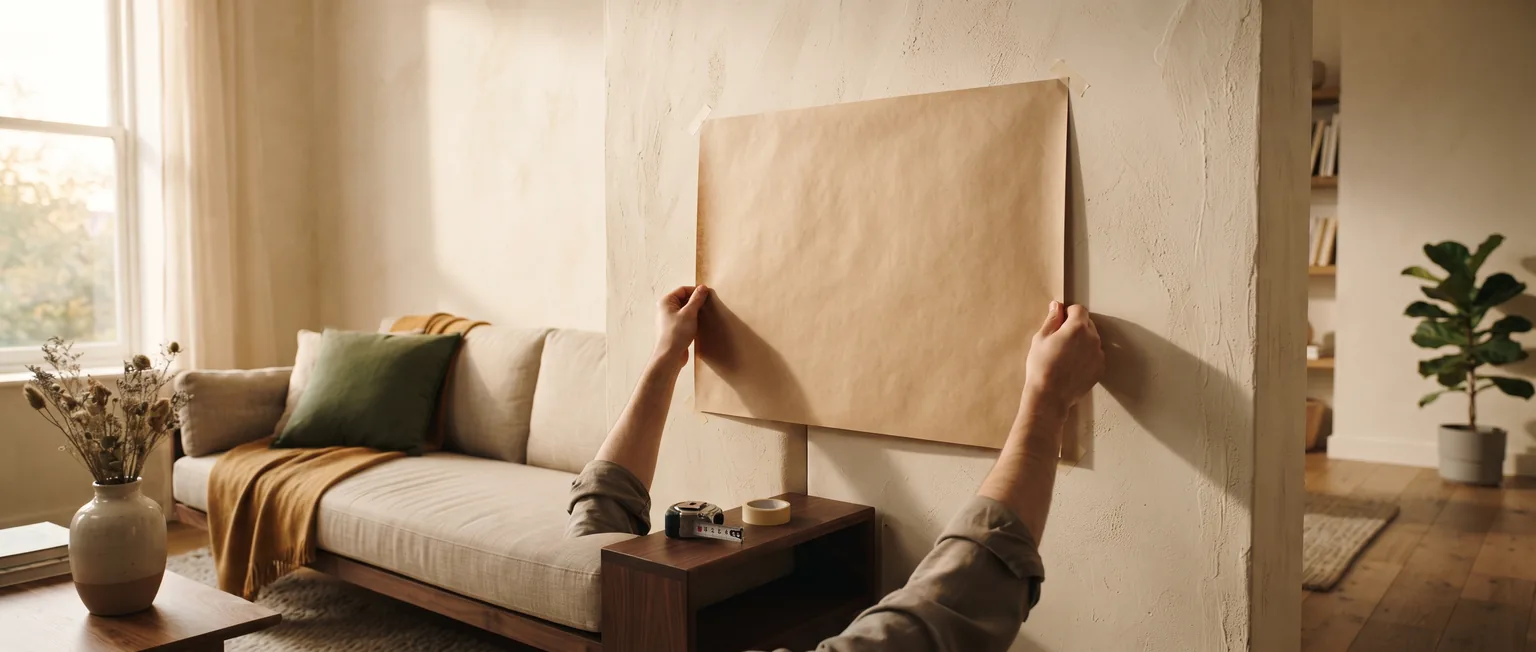
Mark the outline on the wall with masking tape, or cut it out of newspaper and tape it up. Then look at it from the three places you will actually see it from: the doorway, the nearest seat, and the longest sightline in the room.
Leave it there for a day. Most people who do this move up one size, and almost nobody moves down.
05Hanging height
Hang the centre of the painting at about 145 to 150 cm from the floor, which is eye level for most adults standing, and is the height galleries use. Above a sofa or a sideboard, drop that so the bottom edge sits 20 to 30 cm above the furniture: the two should read as one group rather than two objects that happen to share a wall.
06When to go bigger
Undersizing is the regret we hear about; oversizing almost never is. Go up a size when the wall is wide and otherwise empty, when the ceiling is high, when the painting is seen from more than four or five metres, or when it is the only thing on that wall. Go down when the wall is broken up, when the room is small and the viewing distance short, or when the painting will hang beside others.
Cost is not a reason to hesitate over a big canvas: shipping is free at every size, so the only difference between 100 cm and 150 cm is the price of the painting itself.
Paintings in this guide





Questions people ask
Why are the sizes not round numbers?
Because each one preserves the proportions of that particular painting. Rounding a 62 x 50 up to 60 x 50 would mean cropping or stretching the work, which we do not do.
Can I order a size that is not listed?
Ask. A size outside the ten is handled as a made-to-order piece rather than a catalogue purchase, with its own quote and timeline. The contact page reaches an advisor, and the commission desk handles anything painted from scratch.
Centimetres or inches?
Both. The size table has a switch at the top; the price does not change with the unit, only the way the same dimensions are written.
Does a larger painting cost more to ship?
No. Shipping is free worldwide by express courier whatever the size, the weight or the destination, and no shipping line is added at checkout. Very large pieces do affect the framing options, which the delivery guide explains.
When the size is settled, the next decision is how it should arrive: rolled for the simplest journey, stretched to hang straight away, or framed.
Other guides
Hand-painted oil or fine art print
Every painting here is offered in two forms. One is painted with a brush and has a surface you can see across the room; the other is printed and has none. The image, the sizes, the framing and the free shipping are identical.
Rolled, stretched or framed
Three ways to receive the same canvas. One of them decides what you have to do when the parcel is opened, and whether you choose a frame now or leave it open.
Room by room
A painting is judged in the room it hangs in. Light, viewing distance and what the room is for decide the subject and the scale far more than taste does.
Commissioning from your photograph
When the painting you want does not exist, it can be painted from a picture you send. What decides the result is the photograph you choose and the size you settle on before the first brushstroke.
Living with an oil painting
An oil on canvas outlives the people who buy it, provided three things are right: where it hangs, what light falls on it, and what you do - and never do - when it needs cleaning.