 French
 German
 Italian
 Arabic
 Japanese
 Spanish
 Korean
 Russian
 Portuguese
 Dutch
Dutch
 Norwegian
 Finnish
 Swedish

How your painting arrives: rolled, stretched or framed
Three ways to receive the same canvas. One of them decides what you have to do when the parcel is opened, and whether you choose a frame now or leave it open.
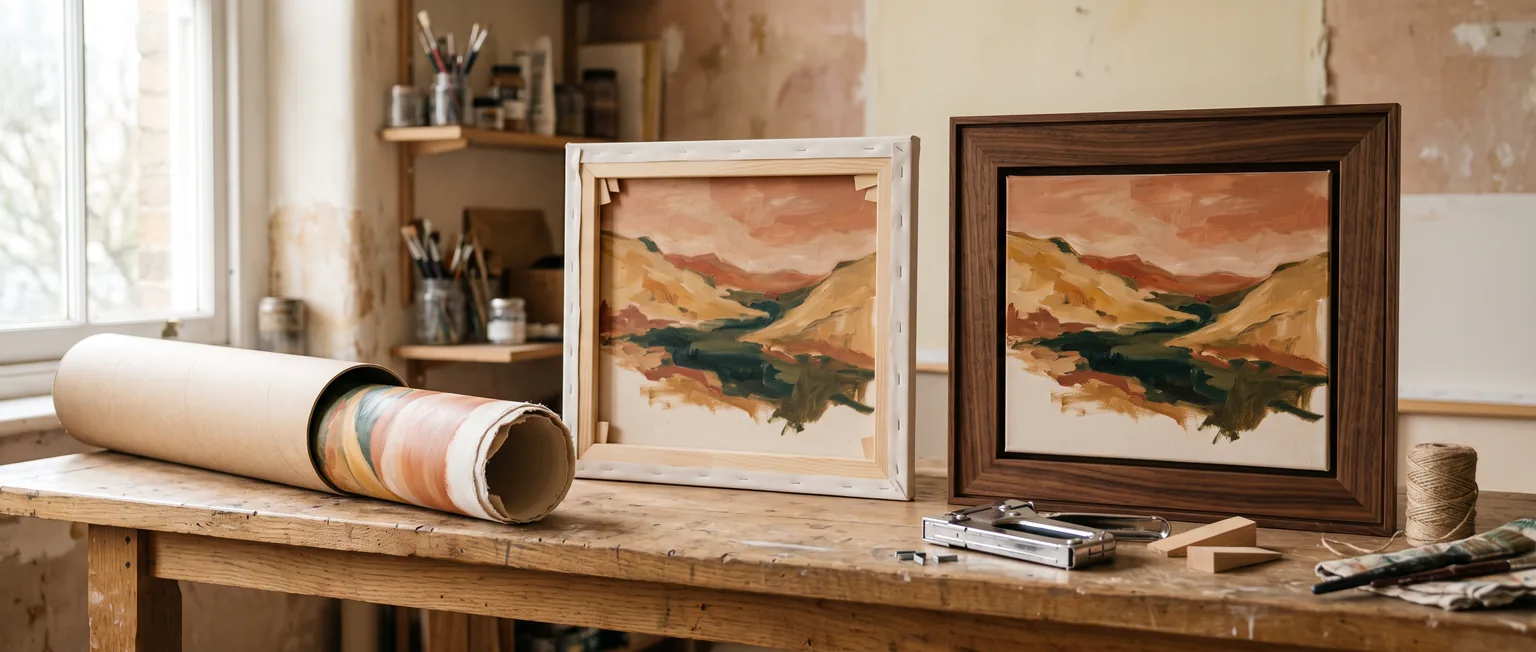
01Rolled
The canvas travels rolled in a tube, without a stretcher and without a frame. It is the most compact and the most robust way to send a painting a long distance, and it is the cheapest of the three because you are buying only the painting.
What it asks of you is one errand: any local framer will stretch it on a chassis and, if you want, frame it. That is also its advantage. You choose the moulding in person, against your own wall, months later if you like.
On the very largest sizes, framing here is arranged on request rather than offered in the panel, and the page says so where it applies.
02Stretched on its chassis
The canvas arrives already mounted on a wooden stretcher, taut, with the sides finished and hanging fixtures in place. You take it out of the box and hang it.
Without a surrounding moulding it reads as contemporary: the painting stops where the canvas stops. On a plain wall, in a modern room, or in a group of several works, that edge-to-edge look is often better than any frame would be.
03Framed
Stretched, and then set inside one of the mouldings offered on the product page. It arrives finished, and it is the only option where nothing at all is left to arrange after delivery.
A frame does two things: it closes the composition, so the eye stops at the painting instead of drifting onto the wall, and it connects the work to the room's own woodwork. That is why a frame that suits one painting can be wrong on the next one.
04Choosing among the frames
Every painting offers the same range, from thin mouldings of about 2.5 cm to wide ones of up to 7 cm. Three rules cover most cases.
- Match the width to the canvas. A thin moulding disappears on a 150 cm painting; a 7 cm one crushes a 40 cm study. Wider canvas, wider frame.
- Match the finish to the subject, not to the sofa. Gold and ornament belong with classical and religious subjects; plain black or white with modern and graphic ones; brown and dark wood with landscapes and interiors.
- Let the room's woodwork decide the tie-break. Skirting, doors and furniture already set a tone. A frame that agrees with them looks deliberate; one that agrees only with the painting looks imported.
05Use the preview before you commit
Selecting a frame on the product page redraws the painting inside that exact moulding, at the size you have chosen. It is not a generic illustration: it is your painting with your frame, which is the only way to tell that a gold ornament overwhelms a quiet landscape.
Go through four or five before you decide. The comparison takes a minute and is far more reliable than a name on a list.
06The three cost the same to ship
Shipping is free worldwide in all three cases, and is not affected by weight or destination. What does differ is what happens after the parcel arrives: rolled means one errand, stretched means a hook, framed means nothing at all. The shipping terms give the transit windows, and the return policy covers the rest: 30 days after delivery to return a painting for a full refund, and a replacement or a refund at no cost if it arrives damaged.
Paintings in this guide




Questions people ask
Is a rolled canvas difficult to stretch?
Not for a framer. It is a routine job, priced by the metre almost everywhere, and it is what most framing shops do more often than anything else. It is not a job to attempt at home the first time.
Can a rolled canvas be damaged in the tube?
It is the safest of the three for a long journey, which is why it is offered at all: there is no glass, no rigid corner and nothing to crush. Should it arrive damaged, send photographs within 30 days of delivery and it is replaced or refunded at no cost, as the return policy sets out.
Can I change the frame later?
Yes. A stretched canvas can be framed at any time by a local framer, and a framed one can be re-framed. If you know you want to decide in person, order it rolled or stretched.
Which frame width for a large painting?
The wide mouldings, from roughly 4 cm to 7 cm, exist for exactly that. On a canvas of 125 cm or more a thin frame reads as a line rather than a border, and the painting looks unfinished at the edge.
The presentation decided, what remains is where the painting goes, which is less a matter of taste than of light and distance.
Other guides
Hand-painted oil or fine art print
Every painting here is offered in two forms. One is painted with a brush and has a surface you can see across the room; the other is printed and has none. The image, the sizes, the framing and the free shipping are identical.
Choosing the right size
Almost every painting here comes in ten sizes, all of which keep its original proportions. Which one is right is decided by the wall, the distance you see it from and the furniture beneath it, not by the painting.
Room by room
A painting is judged in the room it hangs in. Light, viewing distance and what the room is for decide the subject and the scale far more than taste does.
Commissioning from your photograph
When the painting you want does not exist, it can be painted from a picture you send. What decides the result is the photograph you choose and the size you settle on before the first brushstroke.
Living with an oil painting
An oil on canvas outlives the people who buy it, provided three things are right: where it hangs, what light falls on it, and what you do - and never do - when it needs cleaning.