 French
 German
 Italian
 Arabic
 Japanese
 Spanish
 Korean
 Russian
 Portuguese
 Dutch
Dutch
 Norwegian
 Finnish
 Swedish

Hanging, lighting and caring for an oil painting
An oil on canvas outlives the people who buy it, provided three things are right: where it hangs, what light falls on it, and what you do - and never do - when it needs cleaning.
01Where not to hang it
Three places shorten the life of an oil more than anything else, and all three are avoidable.
- A bathroom. Sustained humidity slackens the canvas and lifts paint over time. There is no version of this that ends well.
- Directly above a radiator, a fireplace or a heat source. The rising heat is dry and constant, and canvas responds to it by moving.
- In direct sunlight. Ultraviolet fades pigment permanently, and no restoration brings it back.
An interior wall, out of the sun, in a room whose temperature and humidity stay roughly steady, is all a painting asks for.
02Light it indirectly
Aim light at the wall rather than at the canvas, from one side and above. A painting lit head-on loses the very relief that makes it a painting, and a glossy passage will throw the beam straight back at whoever is looking.
Prefer LED. It emits almost no ultraviolet and very little heat, which is exactly the combination a canvas wants. Halogen spots at close range are the opposite on both counts.
03The first weeks
A newly painted oil continues to dry for a long time after it leaves the workshop; touch-dry is not the same as cured. For the first weeks, keep it out of tight enclosures, do not press anything against the surface, and do not hang it face to face with another canvas in storage.
A faint smell of oil and solvent in a closed room is normal early on and fades on its own.
04Cleaning, and what never to use
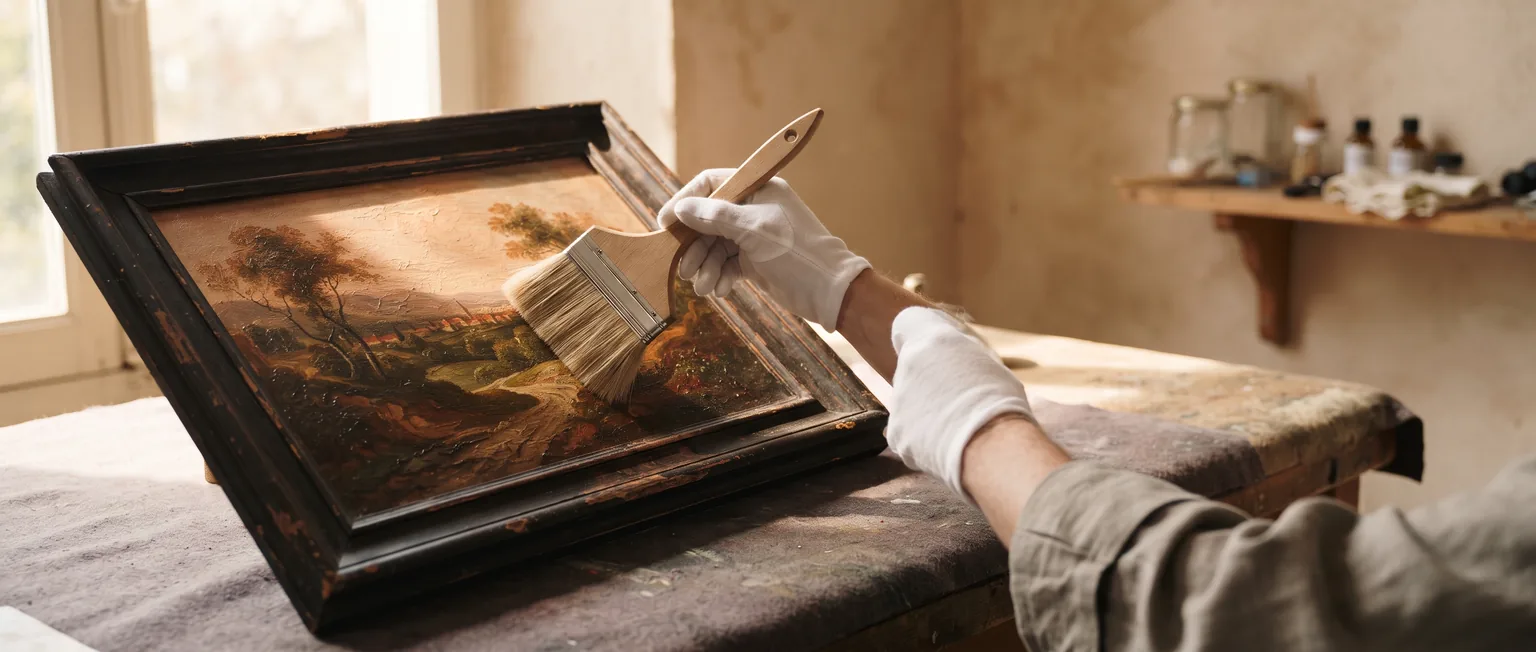
Dust it two or three times a year with a clean, dry, soft brush, working from the top down and touching the surface as lightly as possible. That is the whole routine.
Never use water, soap, alcohol, white spirit, any household cleaner, or a damp cloth. Solvents dissolve paint and varnish, and a cloth catches on raised brushwork and pulls it. Nothing you have under the sink is safe on an oil painting. Anything beyond dust - a stain, a mark, a yellowed varnish - is a job for a restorer, and it is not urgent enough to justify improvising.
05Moving and storing
Carry a stretched canvas by the stretcher bars, never by the top edge alone and never with a hand flat against the back of the fabric.
If a painting has to be stored, stand it upright, face out, with a spacer between it and anything else, in a room that is neither damp nor hot. A rolled canvas is rolled paint-side out around a wide tube, never paint-side in: rolling the paint inward compresses it and it cracks.
06If something goes wrong
Damage in transit is rare and is dealt with straight away: photograph the parcel and the painting, and send both within 30 days of delivery, and the painting is replaced or refunded at no cost. The same applies to a clear defect in the workmanship or to a painting that does not match what was ordered. The return policy sets out exactly what is needed, and the contact page is the route.
For damage that happens years later, in your own home, a local restorer is the right answer rather than a shipment back across the world.
Questions people ask
Does an oil painting need varnishing?
Not by you. Varnishing is done when the paint is fully cured, and it is a restorer's or a painter's job. An unvarnished painting kept out of sun and damp is in no danger.
Can I hang a painting in an air-conditioned room?
Yes, and a stable air-conditioned room is better for a canvas than an unstable one. What matters is that temperature and humidity do not swing sharply; a vent blowing directly onto the canvas is worth avoiding.
My painting arrived rolled. How long can I leave it in the tube?
Unroll it within a few weeks rather than leaving it for months, and have it stretched by a framer as described in the delivery guide. Left rolled for a long time, a canvas keeps the curve.
How do I know if a mark is dirt or damage?
If a light dry brush does not lift it, treat it as damage and stop. Rubbing at a mark on an oil painting turns a small problem into a permanent one faster than almost anything else.
Out of the sun, off the radiator, dusted with a dry brush and otherwise left alone: that is a painting still hanging a century from now.
Other guides
Hand-painted oil or fine art print
Every painting here is offered in two forms. One is painted with a brush and has a surface you can see across the room; the other is printed and has none. The image, the sizes, the framing and the free shipping are identical.
Choosing the right size
Almost every painting here comes in ten sizes, all of which keep its original proportions. Which one is right is decided by the wall, the distance you see it from and the furniture beneath it, not by the painting.
Rolled, stretched or framed
Three ways to receive the same canvas. One of them decides what you have to do when the parcel is opened, and whether you choose a frame now or leave it open.
Room by room
A painting is judged in the room it hangs in. Light, viewing distance and what the room is for decide the subject and the scale far more than taste does.
Commissioning from your photograph
When the painting you want does not exist, it can be painted from a picture you send. What decides the result is the photograph you choose and the size you settle on before the first brushstroke.