French
 German
 Italian
 Arabic
 Japanese
 Spanish
 Korean
 Russian
 Portuguese
 Dutch
Dutch
 Norwegian
 Finnish
 Swedish

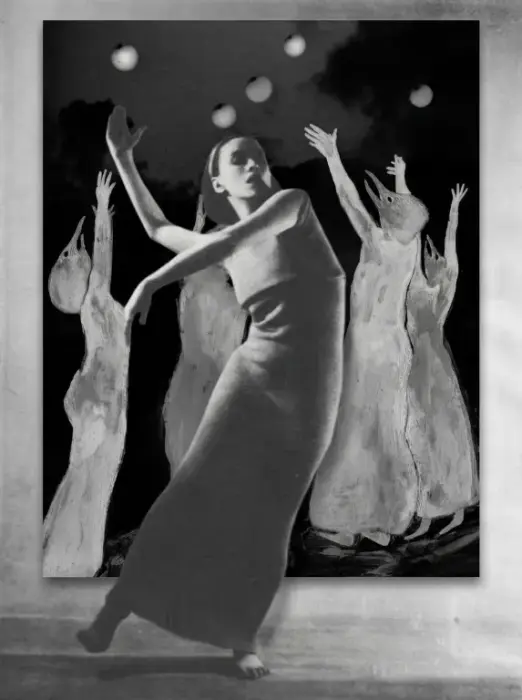
Table of content
- When the Face Becomes the Final Mask
- The Mask as Permission to Be Honest
- Rituals Without Deities
- The Red Thread and Invisible Bonds
- Staying With What Has No Answer
Through the works of Julia Soboleva (Latvia, 1990)
When the Face Becomes the Final Mask
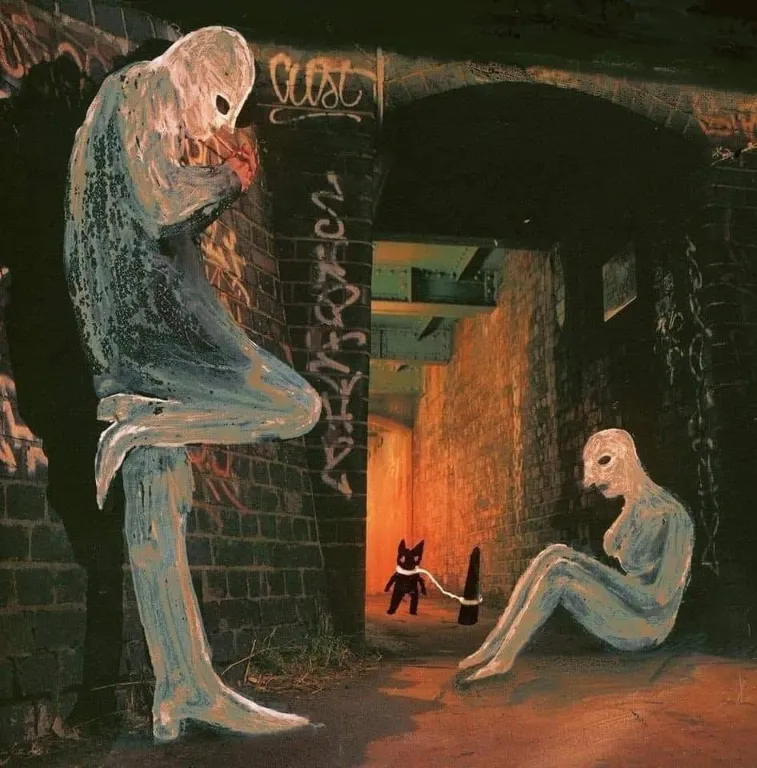
At first glance, the figures in Julia Soboleva’s paintings hardly resemble human beings. They wear bird masks, animal heads, hollow eyes; human bodies paired with faces that reject all familiar features. Yet at the very moment the viewer registers this strangeness, another sensation emerges simultaneously: the feeling of being seen through. Soboleva does not conceal the human behind the mask; on the contrary, she uses the mask to expose the rawest aspect of modern human nature — a self that has learned to survive by fragmenting itself. When the familiar face is stripped away, what remains is not fiction, but a more difficult form of truth: the human being in a primal state of roles and instincts.
The Mask as Permission to Be Honest
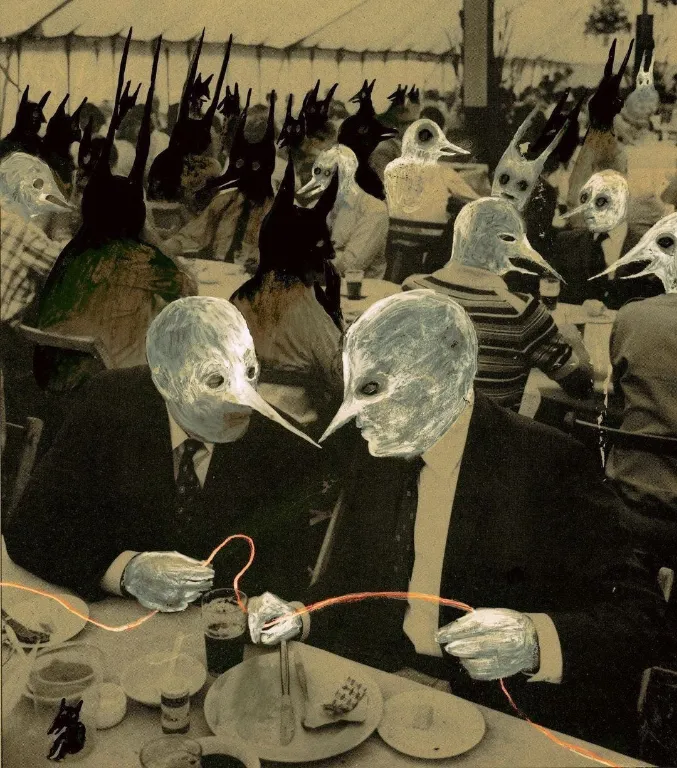
In psychological life, a mask has never meant mere concealment. It is permission. Permission to express fragile, instinctual, or inconvenient parts that social life often forces us to suppress. Soboleva’s figures wear masks while eating, gathering, standing in line, participating in unnamed rituals. They are no different from us — except that they have removed the familiar face. And precisely because of this, they become more truthful. The viewer recognizes themselves in these forms, when identity is reduced to function: the worker, the compliant subject, the silent observer within a collective. In Soboleva’s world, humans do not need to pretend to be autonomous individuals; they are allowed to exist as adaptive beings.
Rituals Without Deities
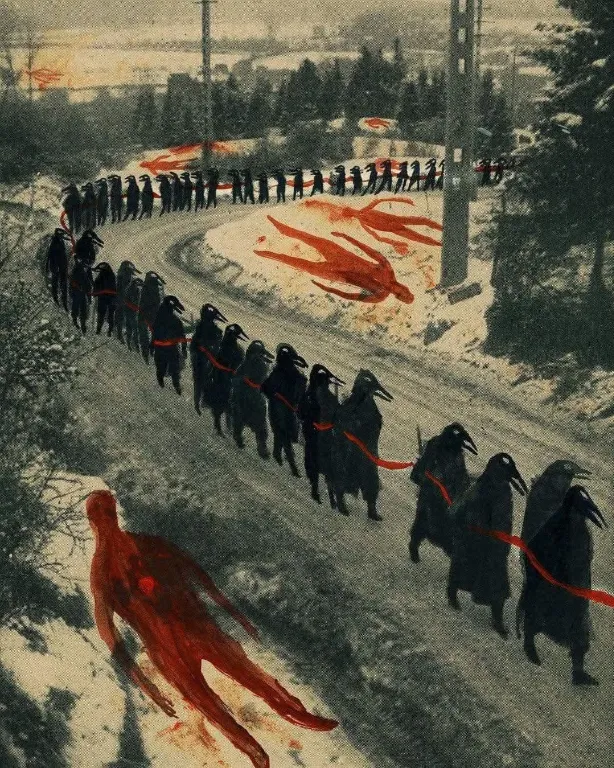
What haunts Soboleva’s paintings is not their surreal quality, but the ritualistic atmosphere that envelops every scene. Groups of people move in synchrony, stand in lines, gather around tables, connected by thin red threads. Something important seems to be taking place, yet there is no explanation, no deity, no promise of salvation. Psychologically, this mirrors a familiar condition of modern life: we continue to perform rituals even as belief has faded, because stopping would mean confronting the void. Rituals no longer serve worship, but structure. They allow people to believe they belong to some order, that moving together can temporarily soothe a quiet, persistent loneliness.
The Red Thread and Invisible Bonds
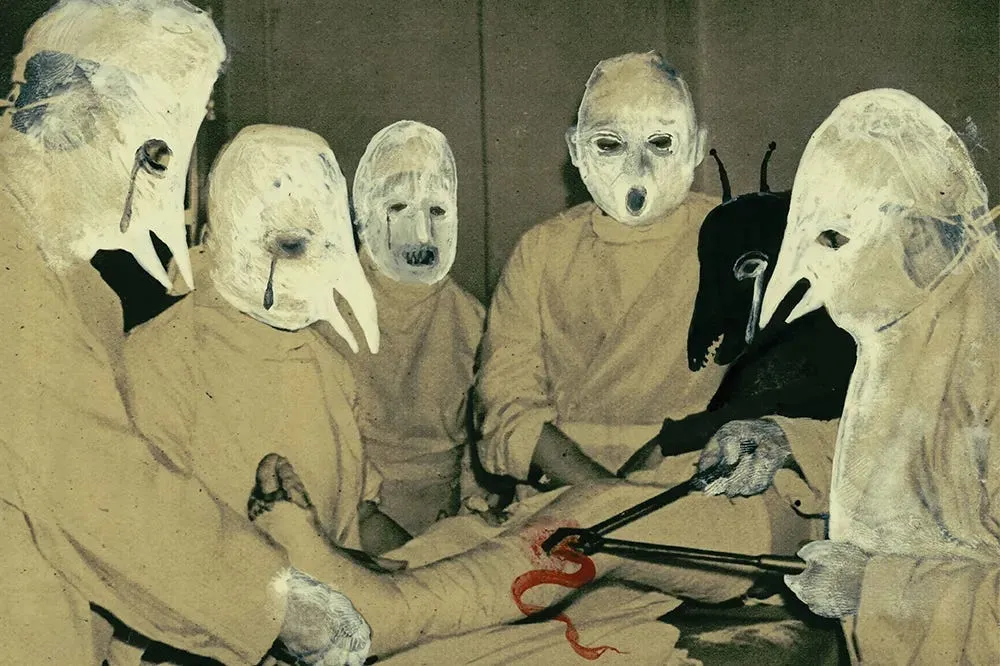
The color red appears repeatedly in Soboleva’s work as a recurring sign — fragile yet persistent. It is thread, paint streak, a trace of memory. In psychology, red is never neutral: it is blood, warning, intimacy, unnamed trauma. The red threads binding figures together evoke the invisible ties that shape human lives — family, history, culture, collective trauma. The figures do not resist these threads. They accept living within them, much as humans learn to live alongside what cannot be fully changed. Soboleva does not speak of healing as escape, but of a quieter form of healing: the ability to remain with what hurts, without denying it.
Staying With What Has No Answer
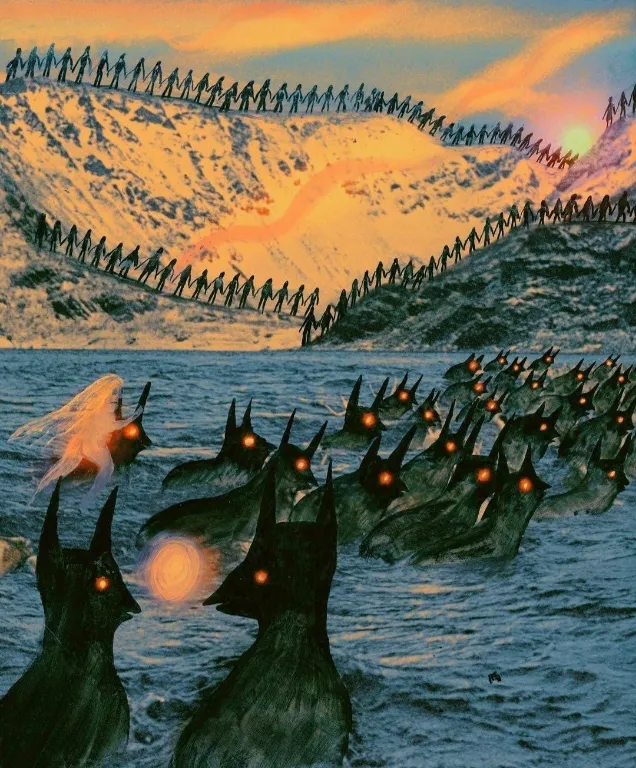
Another motif that holds the viewer’s gaze is the repetition of crowds. Nearly identical bodies, identical postures, identical directions, creating a sense of safety that is also suffocating. Psychologically, crowds are seductive because they diffuse responsibility and allow us to hide. Yet in Soboleva’s paintings, there is always a slight deviation: a figure in a different tone, someone standing just off-center. This difference is not loud, but it is enough to underscore the cost of awareness. When individuals begin to see the structures they belong to, they can no longer merge unconsciously, and that clarity often comes with loneliness. Soboleva neither romanticizes rebellion nor punishes difference. She observes it with a rare gentleness.
What gives Julia Soboleva’s work its lasting weight is restraint. She does not explain, conclude, or guide the viewer toward a final truth. The works remain suspended, much like human psychological life, which rarely offers complete answers. Maturity, in the end, is not about finding solutions, but about carrying internal contradictions without collapse. In a world obsessed with labels, classifications, and certainty, Soboleva’s art whispers something quiet yet courageous: you do not need to fully understand yourself in order to exist fully.
At Lenoir Decor, we believe art is not meant merely to fill space, but to open inner dialogue. Julia Soboleva’s works are not made to be glanced at quickly; they are meant to be lived with, to change alongside the viewer’s emotional states and experiences. If these images awaken in you a feeling that is difficult to name, that may be a sign of connection. You can explore more of Soboleva’s work in Lenoir Decor’s curated catalog, where art does not seek to soothe, but chooses to understand.
Visit our catalog to continue the dialogue between art and the inner self.
.webp)